
Your bones are alive. Right now, as you read this, old bone is being broken down and new bone is being built in a constant remodeling cycle. Until about age 30, you build more than you lose. After that, the balance tips, and for many people the losses accelerate with age. The Bone Health and Osteoporosis Foundation reports that roughly one in two women and up to one in four men over 50 will break a bone because of osteoporosis.
Here is the part most people miss: the best exercises for bone density are not the ones you would guess. Brisk walking helps. Swimming, for all its virtues, barely registers. The skeleton responds to one thing above all else, and that thing is force. In this guide, I break down the seven exercise types with the strongest evidence for building bone density, what the landmark LIFTMOR trial actually proved, how to start safely after 50 or 60, and the nutrition your bones need to turn that exercise signal into new bone.
In This Guide
- The short answer: what actually builds bone
- How exercise builds bone (the science in plain English)
- The 7 best exercises for bone density
- Watch: 7 osteoporosis exercises demonstrated by physical therapists
- My take
- The popular workouts that do almost nothing for your bones
- How to start safely after 50 or 60
- The nutrition your bones need
- How long until exercise increases bone density
- Frequently asked questions
The Short Answer: What Actually Builds Bone
If you want the quick version, here are the seven exercise types with the strongest evidence for increasing bone density, ranked roughly by the strength of the research behind them. Think of this as the short list of the best exercises for bone density that the current science supports:
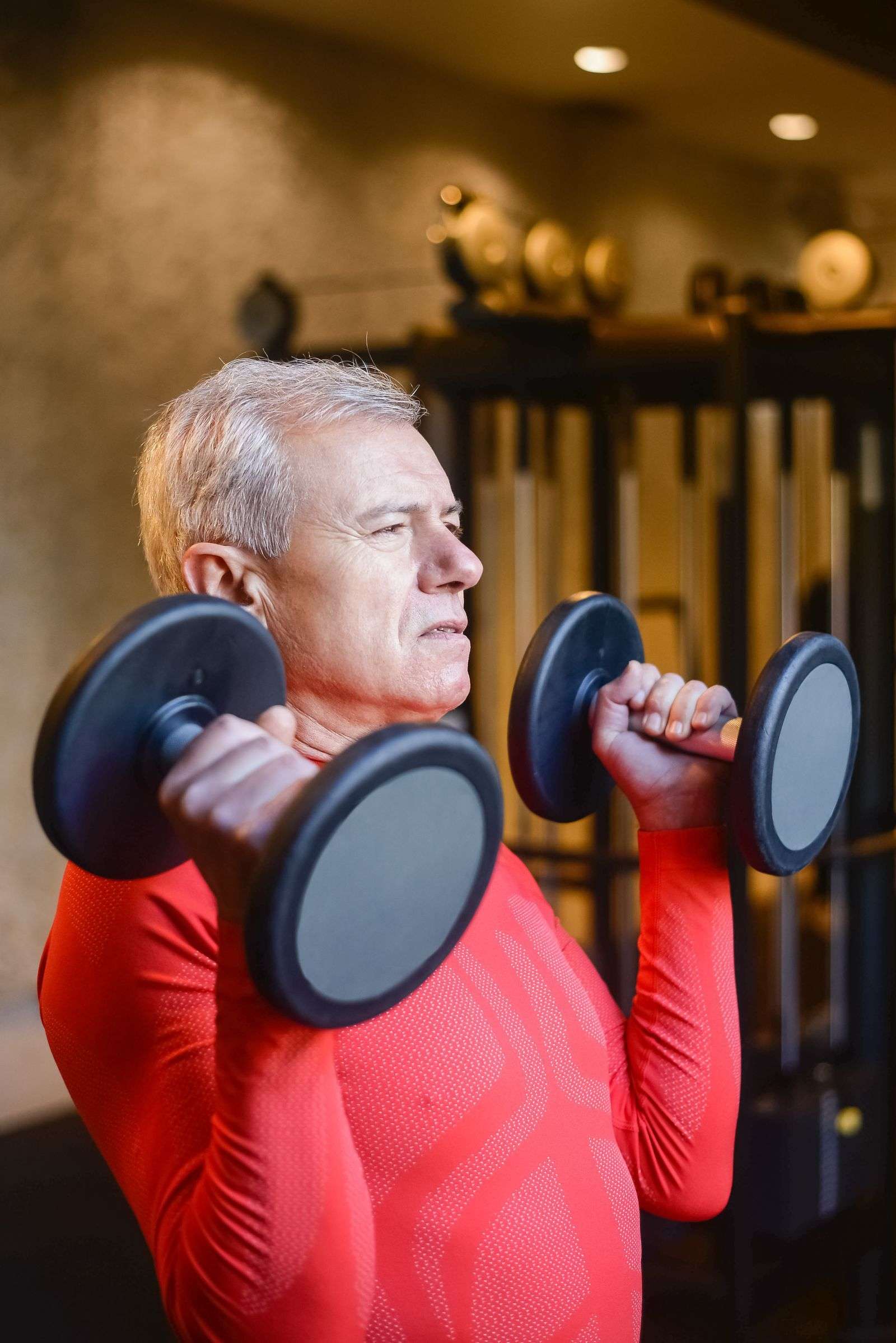
- Heavy resistance training: squats, deadlifts, overhead presses, rows
- Impact loading: jumping, hopping, heel drops
- Brisk walking and jogging: two to three hours per week
- Stair climbing
- Dancing and racket sports: tennis, pickleball, badminton
- Loaded carries: farmer’s walks with dumbbells or kettlebells
- Balance training: tai chi, single-leg stands
The rule behind the whole list is simple. Bone adapts to load. Anything that makes your skeleton carry weight or absorb impact sends the build signal. Anything where something else carries the load for you, like water in a pool or a bicycle seat, mostly does not.
How Exercise Builds Bone: The Science in Plain English
Bone is living tissue, not scaffolding. Two types of cells run a constant renovation project inside you. Osteoclasts break old bone down. Osteoblasts lay new mineral down. When you are young, the builders outpace the demolition crew. With age, especially after menopause when estrogen drops, demolition pulls ahead.
Exercise tips the balance back toward the builders, but only if the signal is strong enough. Your skeleton follows a principle scientists call the mechanostat, a close cousin of Wolff’s law: bone strengthens along the lines of stress placed on it, and it only responds to forces greater than what it already handles every day. A casual stroll does not cross that threshold. A loaded squat does.
Two ingredients send the signal, according to the National Institute of Arthritis and Musculoskeletal and Skin Diseases (NIAMS). The first is resistance, which is your muscles pulling hard on the bones they attach to. The second is brief impact, which is your body working against gravity. Walking and swimming never cross the threshold for your hips and spine in the way that loaded, forceful movement does. Targeted loading does.
There is one more detail that matters. Bone responds where it is loaded. The angle and location of the force decide which bones adapt. That is why a complete program mixes several movement types instead of repeating one, and why the spine and the femoral neck of the hip, the two sites most vulnerable to fracture, deserve direct attention.
The 7 Best Exercises for Bone Density
1. Heavy resistance training: squats, deadlifts, overhead press, rows
This is the single best-studied tool for building bone. The landmark evidence comes from the LIFTMOR randomized controlled trial, published in the Journal of Bone and Mineral Research. Researchers recruited 101 postmenopausal women with low bone mass, average age 65, and randomized them to either eight months of twice-weekly, 30-minute supervised high-intensity resistance and impact training, or a home-based low-intensity program.
The training group did five sets of five repetitions at more than 85 percent of their one-repetition maximum on the deadlift, overhead press, and back squat, plus impact loading through jumping chin-ups with drop landings. The results were striking. Lumbar spine bone mineral density rose 2.9 percent in the training group while falling 1.2 percent in the control group. Femoral neck density held steady while the control group lost nearly 2 percent. Compliance was 92 percent, and across eight months there was exactly one adverse event, a minor lower back spasm. The authors concluded that, contrary to prevailing opinion, this kind of training was effective and produced no serious adverse events under supervised conditions in women with low to very low bone mass.
You do not need to start at 85 percent of your max. The LIFTMOR participants spent their first month on bodyweight and low-load versions while they learned the movement patterns. The lesson is the destination, not the starting line: progressively heavier compound lifts, twice a week, built around the squat, the hip hinge, the press, and the row. If you are building a full lifting program later in life, our complete guide to strength training after 40 covers safe progression, protein targets, and sample 2-day and 3-day routines.
2. Jumping and hopping
Each landing sends a sharp pulse of force up through your hips and spine, exactly the high-rate loading bone responds to best. Research on impact exercise has found that even modest doses, on the order of a few dozen jumps several days per week, can move bone formation markers within weeks. The LIFTMOR trial built jumping chin-ups with drop landings directly into its protocol.
Start where you are. Gentle heel drops, rising onto your toes and dropping firmly onto your heels, are the entry point. Small two-footed hops come next, and only when your joints and your doctor agree. If you already have osteoporosis or a fracture history, check with your physician before adding any impact work.
3. Brisk walking and jogging
Walking is the most underrated bone drug on this list, provided it is brisk. A network meta-analysis published in The BMJ, covering 124 trials and more than 18,000 adults over 40, compared six exercise categories head to head. Brisk walking and jogging came out on top for widespread skeletal stimulation across multiple bone sites. The dose associated with clinically meaningful benefits was roughly 600 MET-minutes per week, which works out to about two to three hours of brisk walking.
Brisk means about 3 to 4 miles per hour, fast enough that talking takes some effort. And the benefits stack with everything else walking does for you. I have written before about the benefits of walking after eating for blood sugar, and a ten-minute post-meal walk is a legitimate way to accumulate your weekly bone-loading minutes.
4. Stair climbing
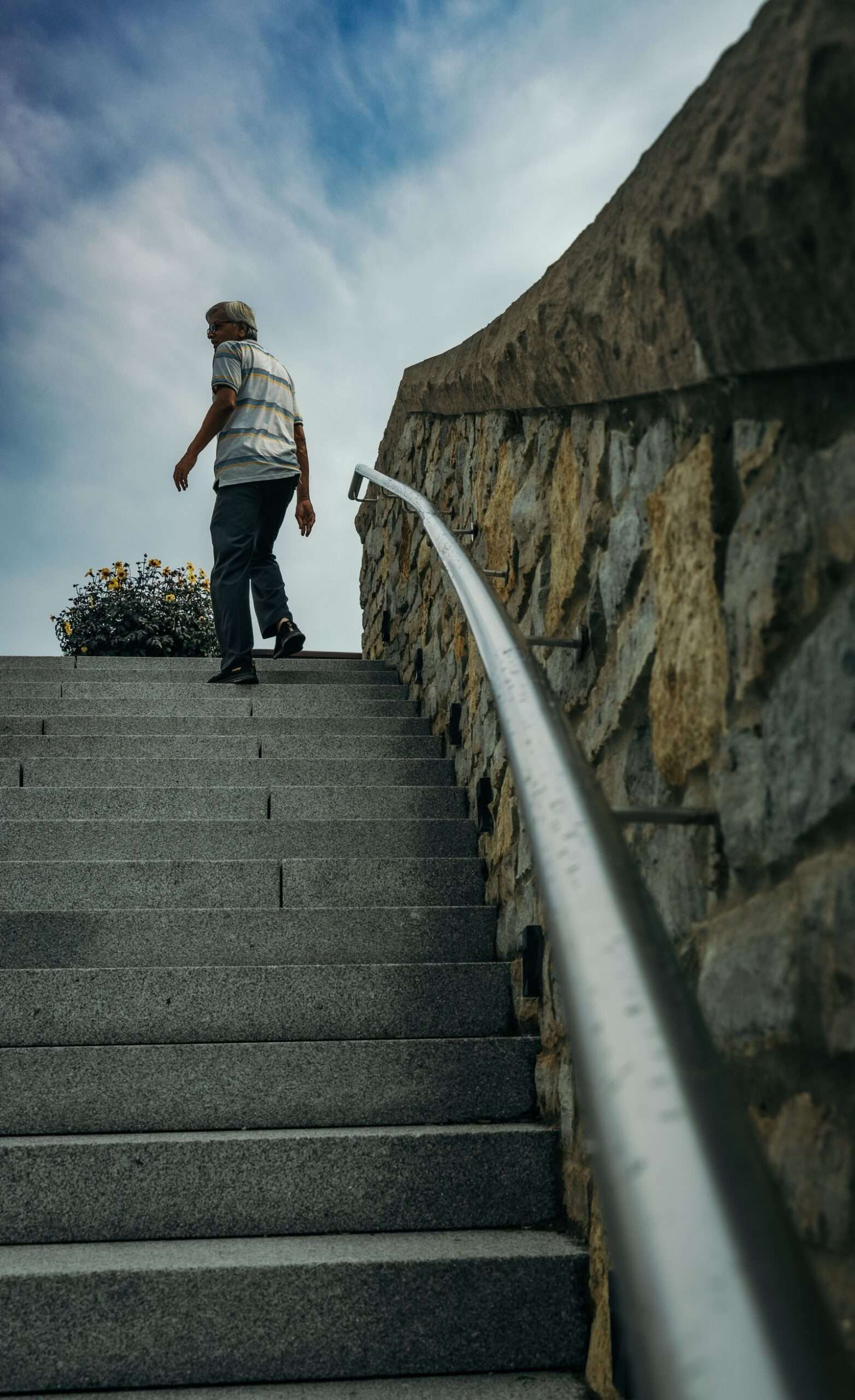
Every step up is a single-leg loaded movement that drives force through the hip and spine. NIAMS lists climbing stairs among its recommended weight-bearing exercises, and it requires zero equipment. Take the stairs at work, do step-ups on a sturdy box or the bottom step at home, and hold a rail until your balance earns your confidence.
5. Dancing and racket sports
Tennis, pickleball, badminton, and dance all load the skeleton in varied, multidirectional ways, which researchers consider especially favorable for bone. The side-to-side shuffles, quick stops, and jumps are forms of odd-impact loading that a straight-line jog never provides. They also happen to be the most fun entries on this list, and the workout you enjoy is the one you will still be doing in five years.
6. Loaded carries
Pick up something heavy and walk tall. The farmer’s walk, a dumbbell or kettlebell in each hand, loads the entire skeleton at once: grip, shoulders, spine, hips, and legs. It is also brutally honest feedback about your posture, because you cannot carry heavy weights with a slumped spine. Start with a weight you can carry for 30 to 60 seconds with a tall back, and add load or distance over time.
7. Balance training: tai chi and single-leg stands
Balance work builds less bone directly, but it may prevent the fracture that bone density alone cannot. Harvard Health cites a BMJ analysis finding that programs combining balance, strength, and resistance training reduced the odds of falls resulting in fractures by more than 60 percent. Since most fractures happen because someone fell, not simply because a bone was thin, this is half the battle.
Tai chi earns a special mention. A case-control study of postmenopausal women (PMID 12370867) found that regular tai chi practice was associated with significantly slower bone loss in weight-bearing bones. Practice standing on one leg while you brush your teeth, walk heel to toe down a hallway, or join a tai chi class. Your future self will thank you.
Watch: 7 Osteoporosis Exercises Demonstrated by Physical Therapists

In the video above, licensed physical therapists Bob Schrupp and Brad Heineck, the duo behind the popular Bob and Brad channel, team up with Sara Meeks, a physical therapist who has specialized in osteoporosis and low bone mass care since 1984. Together they demonstrate seven exercises built around two themes: pelvic presses in four progressions, from basic to advanced single-leg versions, and foam roller work for spinal support and posture.
What I like about this video is its restraint. Nobody is shouting about miracle cures. Meeks walks through each movement with clear form cues, explains the progressions honestly, and the whole session is designed for people who are genuinely worried about their bones, not for athletes. It pairs well with everything above: the article gives you the why and the program structure, and the video shows you what safe, targeted loading actually looks like in a living room.
My Take
I will be honest with you: this one stung a little. I was on the varsity water polo team and the varsity swim team in high school, and swimming has been my sport for most of my life. Learning that the pool does almost nothing for bone density felt like finding out a longtime friend had been lying to me. But the science is the science, and it changed how I train.
These days I lift every other day on a three-day rotation, and I treat the weights as non-negotiable, not optional. The pool is for my heart and my head. The weights are for my skeleton. When I was younger and shooting in Jamaica under brutal stress, I worked out like a maniac to cope: I would run to the Caribbean Sea and jump in first thing in the morning, swim in the ocean, shoot all day, and then go lift weights in the gym at night. I wrote in my book that if it was not for my exercise, I would have gone absolutely insane, because exercise has direct stress-busting benefits, it pumps you up with natural endorphins, and running, swimming, and lifting weights bump up your brain’s feel-good neurotransmitters. I have also written about how exercise is one of the most reliable ways to lower cortisol naturally, and that stress angle is real for me.
Here is what I want you to take from my experience rather than just the studies. I did not start lifting to protect my bones. I started because it kept me sane and because I liked how it made me look and feel. The bone density benefit was a bonus I only understood years later. That is the trick with all of this: pick the version you will actually keep doing. If heavy barbells intimidate you, start with the dumbbells in your living room, or the stairs in your building. The skeleton does not care about your gym membership. It cares about load, and it keeps score for decades.
Want one practical health breakdown like this in your inbox every morning and evening? Join The Biohack newsletter and get our latest video guides, summaries, and takes delivered straight to you. It is free, and you can unsubscribe anytime.
The Popular Workouts That Do Almost Nothing for Your Bones
Honesty requires the other side of the list. Some of the most popular workouts among older adults are excellent for the heart, the joints, and the mood, and nearly useless for bone density.
Swimming
The water holds you up, which is precisely the problem. With buoyancy carrying your body weight, your skeleton experiences almost no loading. NIAMS classifies lap swimming as non-weight-bearing exercise. Swim for your heart, your lungs, and your sanity, just do not count it as bone training.
Cycling
The saddle carries your weight, so your hips and spine get little of the loading signal. NIAMS likewise lists indoor cycling as non-weight-bearing. Same verdict as swimming: wonderful cardio, not a bone builder.
The elliptical
Ellipticals are engineered to remove impact, which removes exactly the stimulus bone needs. Fine for arthritic knees, but it will not move your bone density numbers.
The fix is not to quit these activities. It is to add twenty to thirty minutes of real loading, twice a week, alongside them. That small addition is what separates a heart-healthy routine from a bone-healthy one.
How to Start Safely After 50 or 60
The evidence says the signal still works at 50, 70, and even 90. It also says the entry point matters more than the destination. Here is how to begin without getting hurt.
Get medical clearance first if you have low bone density
If you have osteopenia, osteoporosis, or a history of fractures, talk to your doctor before starting, as both NIAMS and Harvard Health advise. A physician or physical therapist can tell you which movements are safe for your specific situation. This is not a formality. It is the step that keeps a good program from causing the injury it is meant to prevent.
Start light and progress slowly
Harvard Health recommends starting with light weights and few repetitions, then adding roughly one repetition per week until you can do a full set of eight to twelve. If you are new to lifting, consider a few sessions with a physical therapist or certified trainer to learn the patterns. Remember that the LIFTMOR participants spent their entire first month on bodyweight and low-load versions before touching heavy weights.
Protect your spine under load
The one form rule that matters most: keep your back tall and straight under load, never rounded and loaded. If you have already had spinal fractures, Harvard advises avoiding forward bending, reaching down, twisting under load, and heavy lifting until your doctor clears you. Learn the hip hinge, pushing your hips back with a flat back, before you pick up anything heavy.
Add balance work from day one
Balance training carries almost no injury risk and starts paying off immediately in fall prevention. Single-leg stands, heel-to-toe walking, and tai chi can begin this week regardless of your strength level.
The Nutrition Your Bones Need to Turn the Signal Into Bone
You can send the perfect exercise signal and still fall short without the raw materials. Bone is built from calcium and phosphorus on a protein framework, and vitamin D is what lets your gut absorb the calcium in the first place. Exercise is the architect. Nutrition is the building supply.
Calcium: 1,200 mg per day after 50
Osteoporosis Canada recommends that adults aged 50 and over get 1,200 mg of calcium daily, ideally from food. Good sources include dairy products, leafy green vegetables like broccoli and kale, almonds, tofu made with calcium, sardines and other fish eaten with their bones, and calcium-fortified plant milks and juices.
Vitamin D: 800 to 2,000 IU per day
The same guidance suggests 800 to 2,000 IU of vitamin D daily for adults over 50, since vitamin D is required for calcium absorption. Fatty fish, fortified milk, and sensible sun exposure help, but many adults need a supplement, especially in winter. A blood test is the only way to know where you stand.
Protein: about 1.0 to 1.2 grams per kilogram of body weight
Bone is roughly half protein by volume, and muscle mass protects bone by loading it and preventing falls. Many bone-health guides suggest around 1.0 to 1.2 grams of protein per kilogram of body weight daily for older adults, which is higher than the standard RDA. Spread it across meals rather than loading it all at dinner.
One more quiet factor: recovery happens while you sleep, and deep sleep is when growth hormone does much of its tissue-repair work. Protecting your sleep is part of protecting your bones. I have written about why I use magnesium glycinate for sleep quality, and an evening wind-down routine is one of the highest-leverage habits I know.
How Long Until Exercise Increases Bone Density
Set your expectations honestly. A full bone remodeling cycle takes months, so measurable density changes typically appear after six to twelve months of consistent training. The LIFTMOR trial ran eight months before its final scans. This is a slow-compounding investment, not a thirty-day transformation.
That timeline is also the argument for starting now rather than waiting for a bad scan. Every month of loading is a deposit, and that is the honest answer to how the best exercises for bone density pay off over time. Consistency matters more than any single heroic workout: the LIFTMOR training group showed up for 92 percent of their sessions, and that adherence is a big part of why the results were so clean. Doctors typically repeat bone density scans every year or two, which gives you a natural checkpoint to measure progress.
Frequently Asked Questions
What is the fastest way to increase bone density?
The fastest exercise approach supported by trials is high-intensity resistance training combined with impact work, two to three times per week. In the LIFTMOR trial, twice-weekly 30-minute supervised sessions produced measurable gains in lumbar spine density within eight months. Pair the training with 1,200 mg of daily calcium, 800 to 2,000 IU of vitamin D, and adequate protein, since your body cannot mineralize new bone without raw materials. For people with osteoporosis, prescription medications can increase density faster than lifestyle alone, which is a conversation to have with your doctor.
Can exercise increase bone density after 60?
Yes. The LIFTMOR trial’s participants averaged 65 years old and still gained lumbar spine density. Other research has found resistance training safe and effective even in adults over 80 when properly supervised and progressed. Harvard Health puts it bluntly: if you have been diagnosed with osteoporosis, staying active is exactly what you should be doing. The entry point gets more conservative with age, but the destination does not change.
Does walking increase bone density?
Brisk walking does. In a BMJ network meta-analysis of 124 trials with more than 18,000 adults over 40, brisk walking and jogging were the most effective exercises for widespread bone maintenance, with meaningful benefits at around two to three hours per week. A slow stroll helps maintain more than it builds, because it never crosses the loading threshold. Swimming and cycling, meanwhile, do little for density because the water or the saddle carries your weight.
Is it ever too late to increase bone density?
No. Bone remodels throughout life, and the loading signal works at 50, 70, and beyond. Peak bone mass is built in youth, which is why exercise matters enormously for kids and teenagers, but maintenance and even gains remain possible for decades afterward. The best time to start loading your skeleton was thirty years ago. The second-best time is this week.
How often should I do bone-building exercise?
Two to three sessions per week is the evidence-backed range. The LIFTMOR protocol used two supervised 30-minute sessions weekly. NIAMS recommends at least 150 minutes of moderate-intensity activity per week plus muscle-strengthening activities at least twice a week. Short, consistent sessions beat occasional heroic ones, because bone adapts to repeated loading over months, not to single efforts.
Disclaimer: This article is for educational purposes only and is not medical advice. If you have osteoporosis, low bone density, or a history of fractures, talk to your doctor or a physical therapist before starting a new exercise program.
Which of these seven exercises are you already doing, and which one will you add this week? Let me know in the comments, I read every one.
