
What this guide covers
Sleep stages to the minute. Glucose curves. HRV, VO2 max, all of it logged to the decimal. Then the same person buys a research compound on the strength of a product photo and a purity percentage nobody checked. This guide explains what a certificate of analysis is, which three results on it matter, how to read one in five minutes, and how to verify it with the lab instead of taking the seller’s word. Everything here concerns laboratory research; research compounds are not for human or animal use.
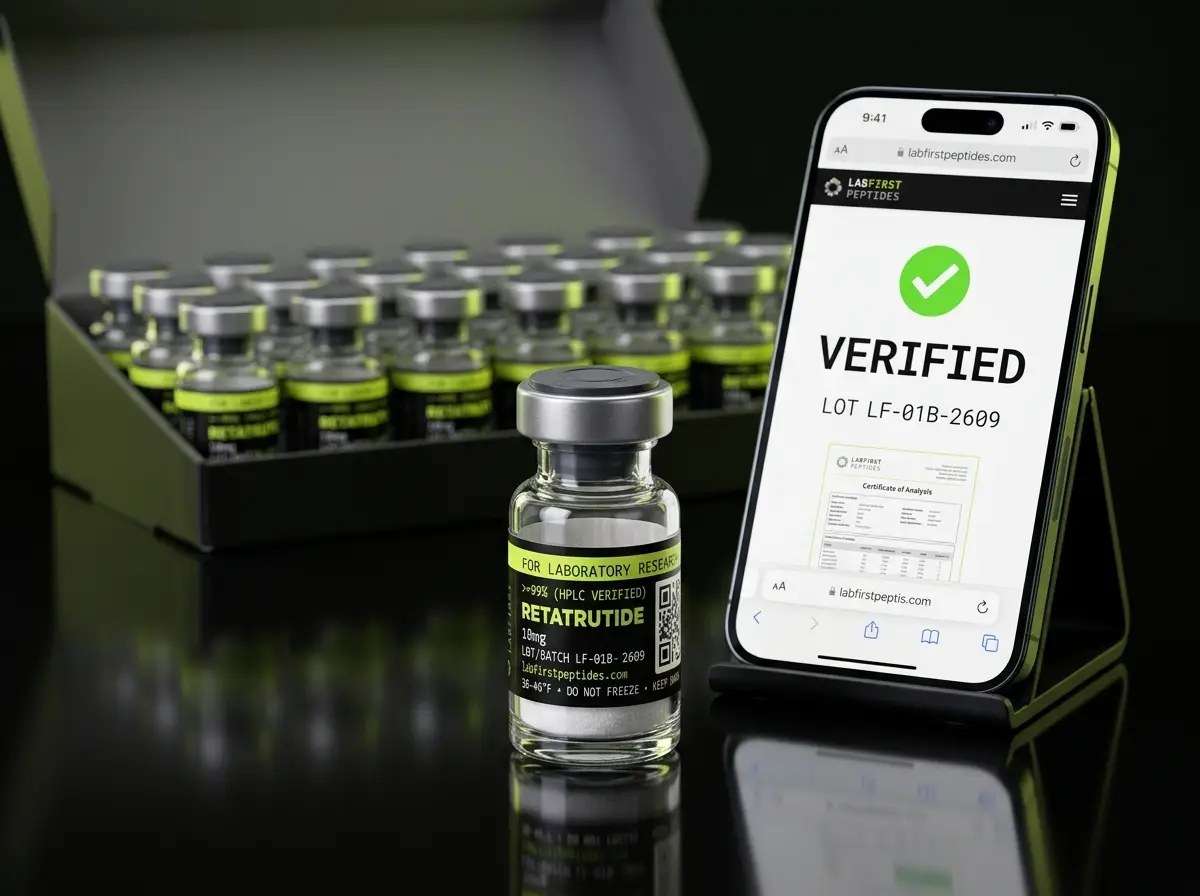
Verifying a certificate with the testing laboratory, LabFirst Peptides
Why isn’t the label the data?
A label is a claim made by the seller. A certificate of analysis is a measurement made by a laboratory on one specific batch. The two should agree, and the only way to know is to read the second one.
The research-chemical market has grown fast, and quality varies widely. Popular compounds attract the most sellers: a retatrutide peptide listing now competes with hundreds of others, and the certificate is the only thing that separates them. Independent testing services that buy products anonymously and publish results have found wide gaps between what labels claim and what vials contain. None of that surprises anyone who has worked on the supply side for more than a month.
Which three results do I look at?
Identity. Is it the right molecule? Labs confirm identity with mass spectrometry, usually liquid chromatography paired with mass spectrometry (LC-MS). The instrument measures the molecule’s mass and the lab compares it with the value the structure predicts. Reference values for many compounds are public in the U.S. National Library of Medicine’s PubChem database. A certificate that shows the measured mass is giving you evidence. One that just says “conforms” is giving you a summary.
Purity. How much of it is the right thing? Purity is measured by high-performance liquid chromatography (HPLC) and reported as a percentage. It tells you how uniform the material is. It does not tell you what the material is, so purity without an identity result is incomplete.
Net content. How much is there? This is the one most often missing. A vial labeled 10 mg contains the compound plus residual water and salts from manufacturing. Net content testing measures the amount of compound against the label. Without it, comparing prices per milligram is guesswork.
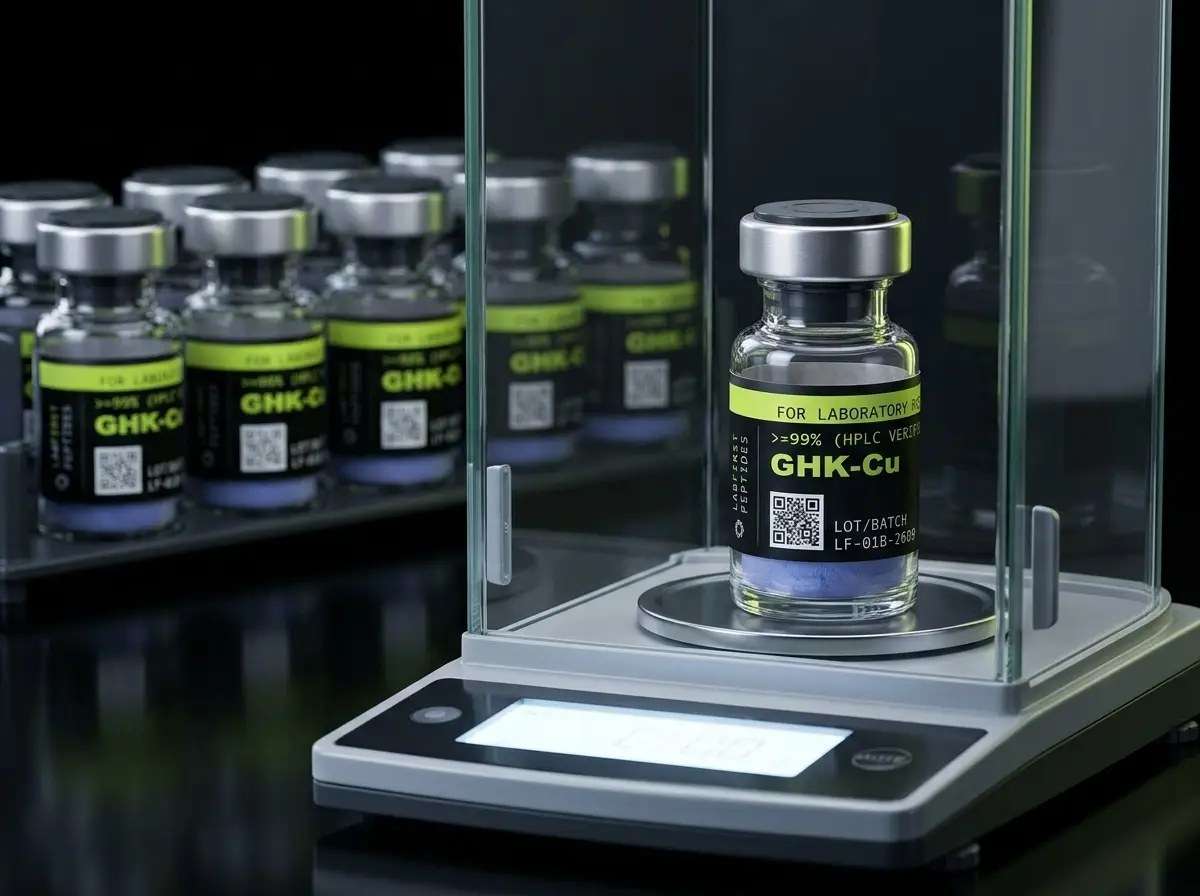
Net content check on a GHK-Cu research vial, LabFirst Peptides
What “third-party tested” actually means
“Third-party tested” is one of the most abused phrases in the supplement and research compound world. At its best, it means an independent laboratory with no financial interest in the sale analyzed the batch and published the results. At its worst, it means a seller paid a lab once, three years ago, and has been citing it ever since.
The phrase tells you nothing by itself. What matters is the evidence behind it: which lab, which batch, which date, and whether you can verify the report yourself. A seller who says “third-party tested” but cannot produce a current, lot-matched certificate is asking you to trust the slogan instead of the data. That is the exact blind spot this guide exists to close.
The same skepticism applies everywhere in the biohacking world. When you are evaluating a probiotic supplement, the label claims about CFU counts and strain lists deserve the same treatment: show me the measurement, not the marketing.
Reading one, in order
Find the lot number and match it to the vial. A certificate not tied to a lot tells you nothing about the vial in your hand.
Check the identity line. Look for the method (LC-MS) and a measured mass or an explicit statement that it matches the reference.
Read the purity result and the method behind it. A percentage with no method is hard to compare.
Look for net content and compare it with the labeled amount.
Note the laboratory and the date. The lab should be findable and the date should fit the batch.
Find the verification route. A lookup code or sample number lets you confirm the report with the lab directly.
What are the red flags?
No lot number, or a lot number that doesn’t match the vial.
A purity figure with no identity result.
The same certificate reused across products or dates.
No way to confirm the report with the issuing lab.
A testing lab you can’t find online.
None of these proves a product is bad. Each one means the certificate can’t be relied on as evidence.
Why the lab itself matters
Not all testing labs are equal, and the certificate is only as credible as the lab that issued it. A serious analytical lab has accreditation to international standards, most commonly ISO 17025, which covers the competence of testing and calibration laboratories. Accreditation does not guarantee every result is perfect, but it means an outside body audits the lab’s methods, equipment, and procedures.
You can check this yourself. Search for the lab named on the certificate. Does it have a real website with a physical address? Does it list its accreditations? Does it offer a way to look up reports by sample number or lookup code? A lab that cannot be found outside the seller’s own website is a red flag, not a technicality.
Also note what the lab actually does. Some labs specialize in food and supplement testing, others in pharmaceuticals or environmental samples. A lab working outside its area of expertise can still produce numbers, but the numbers mean less. Match the lab’s stated capabilities to the test being reported.
How do you verify instead of trust?
Treat a certificate the way you’d treat any data source: check it. Match the lot number to the vial. Look the report up directly with the lab that issued it, using the code printed on it. Compare the measured mass with the public reference. If something doesn’t line up, ask the seller to explain in writing. A seller who gets irritated by that request has answered it.
Some suppliers now publish their quality standard up front: the minimum identity, purity and net content a batch must meet before it ships, with certificates linked from each product page by lot. To see what that looks like in practice, the LabFirst Peptides certificates page lists its own, including each lot’s measured net content.
Making verification a habit
Reading one certificate carefully is good. Building the habit is better. The people who get burned are rarely the ones who checked once and got fooled. They are the ones who checked the first order, liked the results, and then stopped checking.
Batches change. Suppliers change. A certificate from six months ago describes a batch from six months ago, not the vial arriving today. Make lot-matching part of your receiving routine: when a new order arrives, pull the current certificate for that lot before you do anything else. It takes five minutes once you know what you are looking for.
This discipline transfers to every health product with big claims and thin regulation. The red light therapy market has the same dynamic: impressive specifications on the sales page, wide variance in what devices actually deliver. Whether it is a compound, a supplement, or a device, the rule is the same. Trust the measurement you verified, not the claim you read.
Bottom line
For a community built on measurement, the certificate is the measurement that matters before anything else. Read it, verify it, and let the numbers decide. The label gets no vote.
Two things people ask
Is 99% purity enough? Purity alone is not enough. A cleanly made batch of the wrong molecule can still show 99% purity. Identity and net content complete the picture.
Can I check a certificate myself? Yes. Match the lot, look the report up with the issuing lab, and compare the measured mass with the PubChem reference. It proves what one laboratory measured on one batch on one date, and nothing about other lots.
Research compounds discussed here are sold for laboratory research use only and are not intended for human or animal use. This guide is not medical advice.
References
National Library of Medicine, PubChem: https://pubchem.ncbi.nlm.nih.gov/
International Council for Harmonisation, ICH Q6B specifications guideline: https://database.ich.org/sites/default/files/Q6B%20Guideline.pdf
